Akwa Ibom has earned a reputation as one of Nigeria's leading states in infrastructure development. Over the years, successive administrations have invested heavily in roads, schools, hospitals, markets, civic centres and other public facilities that have transformed many parts of the state. However, while impressive progress has been made at the state level, there remains a significant gap in the quality of many projects delivered within the local government areas. If the state is to sustain its reputation for excellence, it is time to establish uniform standards for every public infrastructure project, regardless of who executes it.
It is important to acknowledge that Akwa Ibom State has demonstrated that high-quality public infrastructure is achievable. Under the leadership of Governor Umo Eno, the state has continued to deliver and maintain many flagship projects that reflect careful planning, quality workmanship and attention to detail. From road infrastructure to public buildings and tourism facilities, the state government has shown that citizens deserve infrastructure built to lasting standards.
Likewise, several local government chairmen have distinguished themselves by insisting on quality in the projects executed within their councils, proving that good infrastructure is ultimately a matter of leadership, supervision and accountability rather than simply the size of the budget. These examples should become the benchmark for every local government in the state. Every market, school, health centre and civic facility, whether built by the state or a local government, should meet the same standard of excellence that Akwa Ibom has become known for.
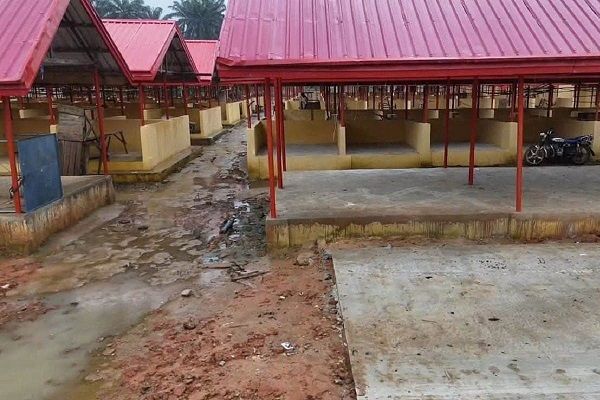
Unfortunately, that is not always the case. Across many local government areas, public projects are often commissioned with grand descriptions such as "modern" or "ultra-modern," yet the finished facilities frequently fail to meet even basic expectations. The market shown in the accompanying photograph illustrates this concern. Although it features roofed stalls and reinforced concrete structures, it falls well short of what most people would consider a modern market.
The access routes and surrounding walkways are unfinished. Many of the stalls have bare concrete floors instead of durable tiled or finished surfaces that are easier to clean and maintain. Drainage appears inadequate, increasing the likelihood of flooding during heavy rainfall. While the structure itself provides shelter, the overall user experience falls far below the standard implied by the phrase "ultra-modern."
A truly modern market should be designed with the comfort, safety and convenience of its users in mind. It should include paved or tiled walkways, effective drainage systems, accessible pathways for persons living with disabilities, reliable water supply, modern sanitation facilities, adequate lighting, proper waste management systems, fire safety equipment, organised parking spaces and landscaping that enhances both functionality and appearance. These are not luxuries—they are the minimum features expected of public infrastructure built in the twenty-first century.
The challenge extends beyond markets. Across Nigeria, particularly at the local government level, contractors are often evaluated primarily on whether they completed the physical structure rather than whether they delivered a high-quality public asset. As a result, projects are sometimes handed over with unfinished surroundings, poor finishing, inadequate drainage and little consideration for long-term maintenance. Buildings may satisfy the technical wording of a contract while failing the everyday needs of the people who use them.
This is ultimately a governance issue. Public infrastructure should not simply satisfy contract specifications; it should satisfy citizens. Every naira spent comes from public resources and should produce facilities that are durable, functional and worthy of public trust. Communities deserve infrastructure that improves their quality of life, not projects that begin deteriorating shortly after commissioning.
Many countries have recognised the importance of legally enforcing construction quality through comprehensive building standards. The United Kingdom's Building Regulations establish minimum requirements covering structural safety, accessibility, drainage, sanitation, ventilation and fire protection. Public buildings cannot simply be declared complete—they must comply with nationally enforced standards before they can be occupied.
Similarly, the Americans with Disabilities Act (ADA) requires public facilities in the United States to provide accessible entrances, ramps, pathways and restrooms, ensuring that people with disabilities can use public infrastructure with dignity and independence.
Singapore's Building Control Act subjects construction projects to rigorous inspections throughout the building process, ensuring that completed facilities meet strict standards of quality, durability and safety. Likewise, South Africa's National Building Regulations and Building Standards Act establishes nationwide requirements governing structural integrity, health, drainage, accessibility and environmental safety.
Akwa Ibom can draw valuable lessons from these examples. The State House of Assembly should consider enacting a Public Infrastructure Quality Standards Law that applies to both state and local government projects. Such legislation would establish clear minimum standards for markets, schools, health centres, roads, parks and other public facilities.
The law should require minimum finishing standards before any project is commissioned; independent quality inspections before contractors receive final payment; standard specifications for flooring, drainage and accessibility; public disclosure of project designs and bills of quantities; mandatory defect liability periods with strict enforcement; community participation during project acceptance; and meaningful penalties for contractors who deliver substandard work.
Professional regulatory bodies such as the Council for the Regulation of Engineering in Nigeria (COREN) and the Nigerian Society of Engineers (NSE) should also play a greater role in certifying completed projects before they are handed over to government agencies or local councils. Independent certification would strengthen accountability and help ensure that public funds deliver lasting value.
Infrastructure is about far more than pouring concrete and erecting roofs. It is about creating public spaces that improve people's daily lives. A market should remain clean and accessible throughout the rainy season. Schools should provide environments that encourage learning. Health centres should inspire confidence in patients. Every public building should reflect the dignity of the people it serves.
Akwa Ibom has already shown that excellence in infrastructure is possible. The next step is to ensure that this standard is applied consistently across every local government. By adopting enforceable quality standards, strengthening oversight and insisting on value for money, the state can ensure that future generations inherit infrastructure that is genuinely modern—not merely described that way at commissioning ceremonies.