The evolution of Niger Delta DevTrack into a comprehensive Governance, Risk, and Compliance (GRC) platform marks a decisive shift in how Host Community Development Trusts (HCDTs) can be monitored, understood, and strengthened under the Petroleum Industry Act.
What began as a simple idea on paper — a transparency-focused reporting platform — has matured into a structured oversight system with the addition of the HCDTs Transparency, Risk Monitoring, and Investment Fund Management Module. This transformation is not incremental. It is structural.
From Transparency Tool to Governance Infrastructure
DevTrack initially positioned itself as a data intelligence layer: a way to track remittances, projects, and compliance disclosures. That alone addressed a major gap. Across the Niger Delta, HCDTs manage significant capital flows derived from upstream petroleum operations. Yet structured, accessible, and standardized reporting mechanisms have been limited.
With the introduction of the HCDTs module, DevTrack moves beyond passive reporting into active governance infrastructure.
The platform now aggregates:
• Statutory remittance data
• Trustee disclosures and tenure tracking
• Audited financial statements
• Project-level budget performance
• Conflict and petition records
• Statutory investment fund allocations
• Annual ROI performance of investment portfolios
This unified architecture creates a single source of truth for each Trust.
Embedding Governance, Risk, and Compliance
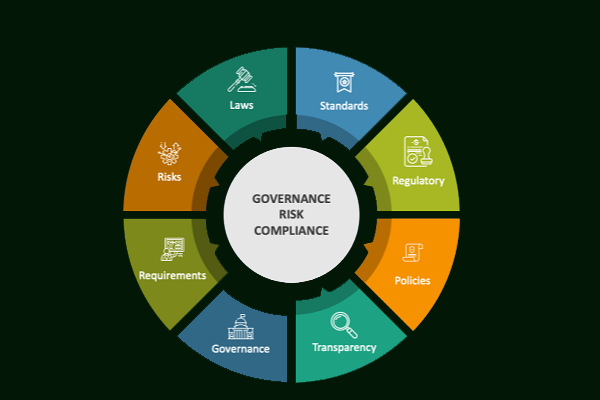
A true GRC system integrates three pillars:
1. Governance — structures, disclosures, trustee oversight
2. Risk — early detection of financial, operational, or compliance vulnerabilities
3. Compliance — adherence to statutory obligations
DevTrack now operationalizes all three.
Governance
Trustee lists are structured and tenure expiry is tracked. Financial statements are uploaded and timestamped. Investment fund managers are documented and verified against regulatory requirements.
Governance becomes visible — not theoretical.
Risk
The introduction of a rule-based risk engine transforms DevTrack into an early warning system. Without relying on complex econometric modeling, the platform flags conditions such as:
• Missing audited reports
• Expired trustee tenure
• Remittance anomalies
• Investment allocation shortfalls
• Negative ROI over consecutive years
• High project budget variances
• Active conflict petitions
Each HCDT is dynamically categorized as Low, Moderate, Elevated, or Critical risk.
This is governance intelligence distilled into actionable insight.
Compliance
Under the Petroleum Industry Act, HCDTs are not informal community associations. They are statutory entities with defined remittance structures, investment obligations, and reporting expectations. The Act is supervised by the Nigerian Upstream Petroleum Regulatory Commission, but regulatory supervision benefits from data infrastructure.
DevTrack provides that infrastructure.
It structures compliance tracking without duplicating regulatory authority. It complements oversight by making compliance measurable and observable.
The Investment Fund: Closing the Accountability Gap
One of the most critical — and historically under-monitored — aspects of HCDT management is the statutory investment fund.
A defined portion of annual remittances must be invested to generate sustainable returns for host communities. These funds are managed by NUPRC-accredited fund managers. In theory, this creates long-term economic resilience. In practice, without structured monitoring, investment performance can become opaque.
The DevTrack HCDT module introduces:
• Clear documentation of allocated investment percentages
• Named and verified fund managers
• Year-on-year ROI tracking
• Portfolio valuation updates
• Trigger alerts for underperformance or non-compliance
By bringing investment oversight into the transparency ecosystem, DevTrack protects the most strategic component of the HCDT framework: sustainability beyond annual remittances.
Lean Architecture, High Institutional Value
Notably, this evolution has been achieved without complex modeling, predictive economics, or opaque algorithms. The system is intentionally rule-driven, administratively simple, and operationally lean.
With a single-admin architecture:
• Data integrity remains controlled.
• Audit logs ensure traceability.
• Public dashboards remain clean and understandable.
• Risk scoring remains explainable.
Explainability is critical. In governance systems, opacity undermines legitimacy. DevTrack’s structured, rule-based approach ensures that every risk classification can be traced back to clear, documented triggers.
This builds institutional trust.
Long-Term Significance for the HCDT Framework
The HCDT component of the Petroleum Industry Act is one of the most ambitious community governance reforms in Nigeria’s petroleum history. Its success depends not only on funding but on management integrity, transparency, and risk control.
DevTrack now provides a digital backbone capable of supporting that success long into the future.
By transforming from a reporting idea into a comprehensive GRC platform, DevTrack achieves four strategic outcomes:
• It becomes a structured oversight instrument.
• It amplifies transparency across Trust operations.
• It enforces investment accountability through performance visibility.
• It operates as a corruption-risk early warning system.
If the HCDT framework is to deliver sustainable development rather than cyclical disputes and financial opacity, it requires standardized monitoring infrastructure.
DevTrack’s HCDT module is not merely a feature expansion. It is the digital architecture that the statutory vision of the Petroleum Industry Act requires to endure.
What started as a simple concept is now positioned as governance infrastructure — capable of reinforcing compliance, protecting community wealth, and institutionalizing accountability in the Niger Delta for decades to come.