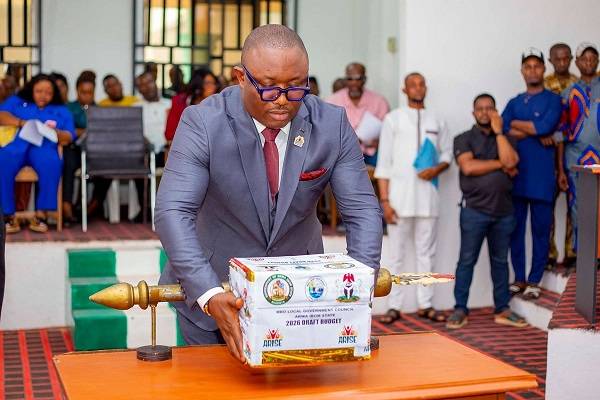
The Chairman of Mbo Local Government Council, Hon. Sunday Etim, JP, has formally presented the 2026 Fiscal Year Appropriation Bill to the 8th Mbo Legislative Assembly, outlining an ambitious ₦13.55 billion budget aimed at deepening grassroots development, expanding infrastructure, and strengthening human capital across the local government.
Addressing councillors and stakeholders, the Chairman described the proposal—aptly titled “The Budget of Sustainable Grassroots Development”—as a clear demonstration of his administration’s commitment to inclusive, people-centred governance. According to him, the budget is not a top-down document, but one shaped directly by community needs, stakeholder consultations, and inputs from elected councillors who serve as the closest representatives of the people.
Hon. Etim explained that the overarching policy thrust of the 2026 budget is to stimulate economic growth, create jobs, reduce poverty, and improve living standards in line with the Sustainable Development Goals (SDGs). Every programme and project, he said, was carefully selected to reflect the real priorities and aspirations of the people of Mbo.
Review of 2025 Performance
The Chairman used the opportunity to review the Council’s performance in the 2025 fiscal year, which was anchored on three key thematic areas: health and nutrition; education; and vocational, life skills development and labour force participation.
Despite economic headwinds, the administration recorded notable achievements. These included the renovation of the Mbo Vocational Craft Centre, the recruitment of Mbo indigenes for vocational training in various trades, and the cultivation of over five hectares of farmland for mixed cropping of plantain and oil palm seedlings to enhance food security.
Other interventions highlighted were the renovation of the Mbo Sports Stadium, the upgrade of the Victor Antai Administrative Block, and the payment of furniture allowances to political office holders. Hon. Etim noted that these efforts reflected a compassionate and future-focused approach to governance, even in the face of limited resources.
2026 Priorities: Infrastructure and Skills
Looking ahead, the Chairman said the 2026 fiscal year would place strong emphasis on massive infrastructural development and expanded vocational and life skills training. New skill programmes, including carpentry, will be introduced at the vocational centre to better equip residents for self-reliance.
Importantly, vocational training will be extended to more youths, with start-up capital provided to the first batch of graduating trainees to enable them transition into economic independence. In agriculture, the Council plans to replicate its farming initiative across all wards, encouraging public participation, job creation, entrepreneurship, wealth creation, and poverty reduction.
Budget Size and Structure
The 2026 budget estimate stands at ₦13,552,519,054. Of this amount, ₦7.85 billion (58%) is allocated to capital expenditure, while ₦5.57 billion (42%) is set aside for recurrent expenditure—signalling a deliberate tilt towards development projects.
By contrast, the 2025 budget, prepared within the Medium-Term Expenditure Framework (2025–2027), stood at ₦6.53 billion. However, revenue performance fell below projections, with only ₦1.09 billion received between January and June 2025. As a result, projected Internally Generated Revenue declined sharply from ₦224 million in 2025 to ₦67.81 million in 2026.
Sectoral Allocations
Out of the ₦7.85 billion capital budget for 2026, the social services sector takes the largest share—₦4.05 billion, representing 51 percent. Education alone accounts for ₦2.86 billion, while health receives ₦1.06 billion. Other social services are allocated ₦137.55 million.
The economic and infrastructural sector is allocated ₦2.31 billion, representing 29 percent of total capital expenditure.
Call for Cooperation
In his concluding remarks, Hon. Etim stressed that the success of the 2026 budget depends on peace, stability, and cooperation among all stakeholders. He reaffirmed his administration’s resolve to deliver programmes with long-term benefits to all communities in Mbo and urged the Legislative Assembly to give the budget timely consideration and passage.